St. Nicholas Day … Hungarian Goulash with Petite Sirah

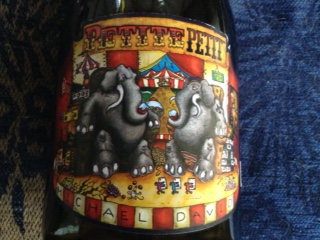
Pairing:  Hungarian Beef Goulash with 2005 Michael David Winery Petite Petit

Food:  December 6 is St. Nicholas Day, a really big deal throughout Europe. The custom of hanging one’s stocking for St. Nicholas to fill with gifts began with the “Legend of St. Nicholas.” The first time we ever heard of the celebration of St. Nicholas Day was in the Kate Seredy’s children’s book, The Good Master. As in the book, we started putting out our boots on the eve of St. Nicholas Day. Because this book takes place in Hungary, we began making Hungarian Goulash as our traditional meal for that day. Our recipe is adapted from Craig Claiborne’s 1971 classic New York Times International Cookbook. Generously season 2 lbs of chuck beef with salt, pepper and paprika. In a heavy skillet, brown the beef in some oil and or butter. Add 2 onions, chopped, until lightly browned. Add one or two Tbs of floor to the beef and onions and cook for a few minutes. Add to the pot 1 and 1/2 cups of beef stock and 2 Tbs tomato paste. Cover and simmer over low heat for about two hours. Check periodically to make sure there is sufficient liquid in the pot. Add more stock if needed. Serve over noodles. Note:  this stew freezes very well, and keeps for a few years in the freezer in case you want to save some for the following year (as we do!).
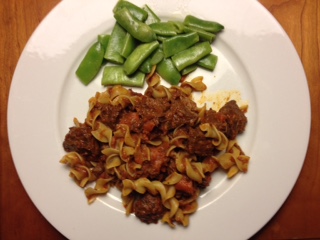
hungarian-beef-goulash

Wine:  OK … this is a little complicated. The Petite Sirah grape (spelled with an i, and also called Durif) is the offspring two varieties, Syrah and Ploursin. Petite Syrah (spelled with a y )  is a clone of the Syrah grape called Petite Syrah because it is smaller in size and yield. Now, to more thoroughly confuse you, this wine from the Michael David Winery in Lodi, California is actually a blend of mostly Petite Sirah and Petit Verdot. Hence, the name Petite Petit. Petit Verdot is often found in small amounts in French Bordeaux and Champagne. Petite Sirah is a relatively rare grape grown primarily in California, but also to a much smaller extent in Australia, Israel, Mexico, Brazil, Chile, and Argentina.
petite-syrah

Tasting:  This Petite Sirah is a deep red (almost black), lush, full-bodied wine that complements the beef goulash particularly well. Blackberry, black currant, and blueberry are all present on the nose. On the palate, these dark fruits come together into a “hedgerow jam” flavor. Add to that some leather, earth, nutmeg and cinnamon and you arrive at an extraordinarily flavorful wine. The paprika notes in the goulash seem to really bring out the spice flavors of the wine.

Other Foods That Pair Well with This Wine:  Steak, Game, Cheese (strong flavored), Mexican Cuisine.

Other Wine That Pairs Well with This Food:  Cabernet Sauvignon, Côte du Rhóne, Zinfandel, Rioja, Shiraz

Read About:  www.michaeldavidwinery.com    http://winefolly.com/review/petite-sirah-wine-guide/  

A Source:  www.wine.com
 

Penne with Fresh Tuna … and Soave

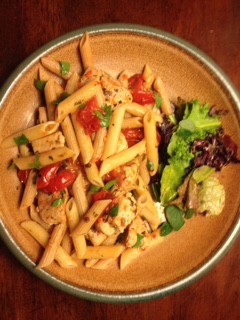
Pairing:  Penne with Fresh Tuna, Herbs and Tomatoes paired with 2013 Le Battistelle Roccolo del Durlo Soave Classico 

Food:  A favorite pasta dish that we have enjoyed many times over the years. Our simple technique is adapted from a recipe in the marvelous cookbook, Diary of a Tuscan Chef. In a few Tbsp of olive oil, sauté some finely chopped garlic and 2-3 Tbs of fresh oregano until slightly browned. Add about 1/2 lb of 1/2 inch cubes of fresh tuna and cook until lightly golden brown, but still slightly pink on the inside. Splash in some of the Soave Classico and scrape up the bits from the bottom of the pan. Add a small box of cherry tomatoes, halved, and cook until softened and some of the juices have melted into the pan. Season with salt, black pepper, and red pepper flakes. Mix everything into some already cooked penne, drizzle with a little more olive oil, and stir in 3 Tbsp of chopped fresh parsley. Check for seasoning and serve with a green salad. Great as leftovers, too!

tuna-with-tomatoes-and-penne

Wine:  Soave Classico is a white wine that comes from the Verona province of northeastern Italy in the beautiful hill country quite far west of Venice. Soave Classico is a region just outside of the town of Soave. The wine in this region is distinguished by the fact that it is made with 100% Garganega grapes, an ancient grape that has been grown in this area since Roman times. It is regarded as one of the finest white wine grapes in all of Italy. Other Soave wine is usually made from a blend of Chardonnay, Pinot Bianco, Trebbiano, and Garganega grapes. Consider, too, that this wine from the Le Battistelle vineyard is very reasonably priced at about $15.

soave-classico

Tasting: Pale gold in color. The nose of this wine reminds one of the smells encountered on a walk through freshly mowed green grass while munching on a Granny Smith apple. Green apple also pervades the palate along with some honeydew melon. A perfect complement to this pasta dish, but one could thoroughly enjoy this wine all by itself. A delight!

Other Wines That Pair Well with This Food:  Pinot Grigio, Un-oaked Chardonnay, Italian Chardonnay, Verdicchio

Other Foods That Pair Well with This Wine: Chicken Salad, Shrimp, White Fish, Pasta in a Light Cream and Seafood Sauce

Read About:  http://winefolly.com/review/how-to-find-great-soave-wine/

A Source:  www.klwines.com

Pan-Fried Trout and a NY Riesling

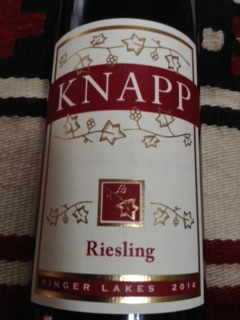
Pairing:  Pan-Fried Trout and Hazelnuts with 2014 Knapp Riesling

Food:  After all that holiday cooking, it’s nice to have a simple, easy-to-prepare meal and something very different from turkey. This pan-fried trout fits the bill on both of these accounts. Whole trout is not always available in the supermarkets, so when we see it, we snatch some up and put them in the freezer. Trout freezes beautifully. For this meal, using a heavy skillet, pan fry the fish in butter and a handful of hazelnuts (whole or halved). Ours is served with brown rice pilaf and broccoli. Simplicity.

trout-with-hazelnuts

Wine:  A gift of wine is always appreciated in our household, particularly when it comes from a brother who really knows his way around the many landscapes of wine. This 2014 Knapp Riesling is from the Finger Lakes Region of upstate New York, a well known wine area where Riesling is king. Some of the best Rieslings made in the United States come from here. Thanks, bro!

knapp-riesling

Tasting:  This demi-sec (off dry) wine has a lovely pale gold color. Ripe cantaloupe melon is prominent on the nose. And there is a pronounced flavor of that same orange melon along with honeysuckle blossoms and hazelnuts (likely brought out by the buttery hazelnuts in the dish). Very nice!

Other Foods That Pair Well with This Wine:  Asian Cuisine, Bluefish, Apples, Blue Cheese, Brie, Curries

Other Wines That Pair Well with This Food: Chenin Blanc, Chablis, Pouilly-Fumé, Champagne.

Read About:  http://www.knappwine.com 

A Source:  The winery itself.

Mother-in-Law Request

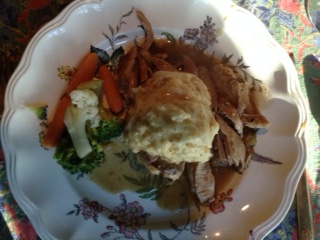
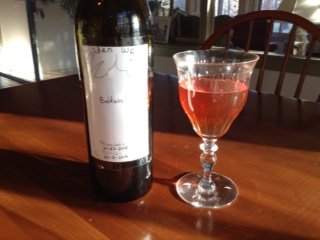
Pairing: Chicken Fricasse with Dumplings and Homemade Baldwin Apple Wine

Food: One year we asked my wife’s mother what food she would like to eat on her birthday.  “Chicken and Dumplings” was her prompt reply.  What a good choice.  While it is a fine way to use up a fowl or old hen, the recipe can be prepared with a young hen, too.  Cut up a 4-5 pound chicken, including the back, and sauté in butter until well browned. Add water to cover, sliced onion, carrot, celery, 4 pepper corns, and simmer for 45 minutes. If the chicken is old, cook for 45 minutes more. Either way, add 2 tsp of salt at this point.  Cool the chicken and strain the broth. Remove the meat from the bones.  Thicken 2 cups of the broth with flour made into a roux with butter. Put the chicken into a stove-top pan (cast iron if you have it) with enough of the thickened broth to come up 3/4 of the way on the meat. Stir in the vegetables from previous cooking and bring to a simmer.  Make dumplings from flour, milk, celery seed, and baking powder.  Dollop the dumplings on the meat and heat uncovered for 10 minutes. Cover and continue to cook for 10 minutes more. Oh my … is that delicious!!

chicken-fricasse

Wine:  Apple wine was the first wine we ever tried to make ourselves. We used apples from an ancient Baldwin apple tree that we preserved when we cleared the land for our house site. It’s impossible to know how the tree is still alive and standing given all the holes in it’s gnarled old trunk. And it still produces the finest of apples about every third year. The apple wine is made from the apples that are particularly ripe (almost rotten!) that have fallen to the ground. We have found that those deadfall apples make the most delicious of wines, with almost a sherry-like quality to it. For those of you who are not yet ready to make your own wine, good commercially-produced apple wine (please … not Boone’s Farm!) is available in many retail liquor stores and apple orchards.

baldwin-apple-wine

Tasting: Apple Wine is most frequently a light to dark golden color. As you can see in the photo above, our Apple Wine has a beautiful, deep blush. The fragrance of the wine is noticeably red apple (not green). No surprise there. The palate is a wonderful combination of apple jelly, red currant jelly, sherry, and honeysuckle. There’s also a touch of spiciness to it. However, this is not a sweet wine. Rather it is more of a semi-dry wine, very much like a Gewürztraminer.

Other Food That Goes Well with This Wine:  Roast Chicken, Pork, Indian Cuisine, Curries, Ham, a Variety of Soft or Aged Cheeses.

Other Wine That Pairs Well with This Food:  LaBelle Apple Wine, Chardonnay, Riesling, Gewürztraminer

A Source:  NH State Liquor Stores

Oktoberfest … errr … Novemberfest (I guess)

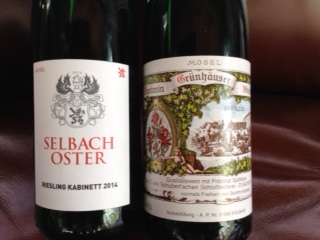
Pairing: Traditional German Food paired with 2014 Selbach Oster Riesling Kabinett and 2007 Maximin Grunhauser Abtsberg Riesling Spatlese.

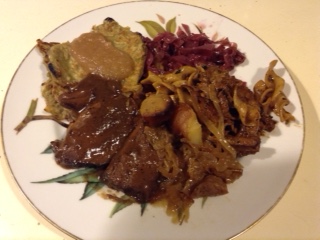
Food: Every fall, sometime between late September and early November, we have friends over for a traditional German meal to celebrate Oktoberfest and our own German heritage. The meal consists of multiple hearty foods that have been part of German culture for eons. The picture below is a plate showing the different foods that make up the feast. Starting withe the front of the plate, we have Sauerbraten (marinated pot roast in a sweet-and sour wine sauce). Moving clockwise there is Kartoffelpuffer mit Apfelmus (potato pancakes with applesauce). Continuing clockwise, we have Rotkohl mit Äpfeln (red cabbage with apples). Further along on the right side of the plate is Hasenpfeffer (jugged hare made with port wine and peppercorns) served with noodles. Finally, in the center of the dish is Sauerkraut and Bratwurst. Looks a bit monochromatic, but the flavors are mind-blowing. Well worth the few days of preparation if you have the time. The recipes we use come from a couple of terrific German cookbooks that date back to the 1950’s and 60’s … Lüchow’s German Festival Cookbook and The Cooking of Germany (part of the Time-Life series Foods of the World). Lüchow’s, located in New York City, was arguably the most famous and highly regarded German restaurant in America for almost 100 years before it closed its doors in 1986.

oktoberfest-meal

Wines:  We should start by saying that a good German beer would be a fine pairing for this meal. However, the foods that comprise the meal are full and rich, so the lightness of wine (versus beer) makes for a nicer complement to the meal. It should be noted that one might think a red wine would be a better pairing given the presence of beef, sausages, and rabbit.  The inherent sweetness and complexity of these white wines, foiled against the vinegar component of several elements of the dish (sauerkraut, red cabbage, and sauerbraten) are good reasons to choose the rieslings over red wines. Both of these wines originate in the Mosel (Moselle) region of Germany, roughly halfway between Luxembourg City and Frankfort. The Mosel River is a tributary of the Rhine and runs near the German border with Luxembourg. The two websites listed below provide wonderful pictures and video of the dramatic, steep landscape that the vineyards are planted in. This region produces the finest rieslings in the world. The terms Kabinett and Spatlese that help identify these wines refer to the time of the grape harvest and the resultant sweetness and complexity of the wine. Kabinett indicates a wine from early harvested grapes, while Spatlese wines are made from grapes left on the vine longer which concentrates the sugars in the grapes more. If the grapes were left on the vine even longer, the wine would be an Auslese.

kabinett-and-spatlese

Tasting:  The youthful 2014 Selbach Oster Kabinett has a vibrant nose with distinct aromas of green apple and green melon. The palate is clean and fresh, mirroring the apple and melon in a just barely ripe state. The blush of youth! The older 2007 Maximin Grunhauser Spatlese has a more refined nose revealing a medley of tropical fruits. The palate is smooth and round, with flavors of honeysuckle and ripe apricot and peach. The sweetness is balanced nicely with the acidity. Despite the differences in the wines, they both go very nicely with this traditional German meal.

Other Foods that Pair Well with These Wines: Asian Cuisine, Turkey, Ham, Pork, Smoked Salmon

Other Wines that Pair Well with This Food:  Most any Riesling from Germany, New York State, or Washington State. Or Spatburgunder Rotwein (German Pinot Noir)

Read About:  http://www.selbach-oster.de/en    http://www.vonschubert.com/en/weingut/

A Source:  www.wine.com


Sunday Dinner … Roast Chicken with a Red Bordeaux

Pairing:  French Roast Chicken paired with a 2005 Balthus Bordeaux Superieur from Château de Reignac

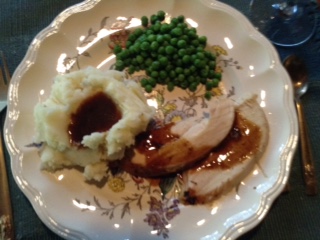
Food:  Every family has a favorite food that everyone loves and doesn’t mind having again and again over the year. In our household, that beloved meal is French Roast Chicken served with mashed potatoes, peas, and rich brown gravy. Maybe some pie for dessert. Now that’s comfort food! To make a simple french roast chicken, stuff the cavity of a whole chicken (about 4-5 lbs) with 1-2 Tbs of tarragon and some cut-up onion, carrot, and celery. Sprinkle more tarragon on the outside of the bird, along with generous shakes of paprika. Lay three strips of bacon across the breast. Roast in a 425 F oven for 30 minutes, then turn down the temperature to 325 F for another hour or so until done. Baste the bird periodically with beef stock while it is roasting. Make the gravy with the pan drippings from the chicken and the basting beef stock.

roast-chicken-serving

Wine:  A few weeks ago I wrote about the versatility of Roast Pork as a food that goes well with so many different types of wine, both red and white. The same thing is true of Roast Chicken. Favorite pairings include Chardonnay, Riesling, Pinot Noir, and Cote du Rhône. This past Sunday, we decided to try a Red Bordeaux. Bordeaux is more commonly paired with strong flavored, rich meats like lamb and beef. It turns out to be a delicious accompaniment to roast chicken as well. This Château de Riegnac Bordeaux Superieur is made from 100% Merlot from old-growth vineyards north and east of the city of Bordeaux.  And, it’s worth noting that 2005 was a fabulous vintage year for the Bordeaux region.

balthus-bordeaux-2-0


Tasting:  Rich, lush ripe dark fruits (notably blueberry and raspberry), along with leather and chocolate are all offered on the nose. Amazing! On the palate, much of these same things can be tasted in a true medley of flavors. The fine tannins are present, but not at all overwhelming. And a pleasant taste of black currant and cedar lingers on the finish. Wow! An exceptional bordeaux.

Other Wines that Pair Well with This Food:  Pinot Noir, GSM, Beaujolais, Chardonnay, Dolcetto

Other Food that Pairs Well with This Wine:  Roast Lamb, Beef, Pheasant, Venison

Read About:  http://www.thewinecellarinsider.com/bordeaux-wine-producer-profiles/bordeaux/satellite-appellations/chateau-reignac-bordeaux-superieur/

A Source:  www.wine.com
Greece and Argentina …a Surprising Pair

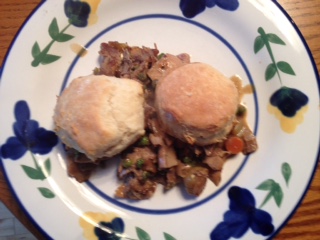
Pairing:  Spanakopita and 2013 Don David Torrontés

Food:  Spanakopita is a traditional Greek pastry made with feta cheese, spinach, and egg. Our recipe is a favorite from an old copy of Craig Claiborne’s NY Times International Cookbook, but there are lots of recipes out there from which to choose. However, our pastry is not made with the usual flakey phyllo dough found in supermarkets. Rather it is a non-layered phyllo called spitiko filo (recipe found in Diane Kochias’s cookbook, Ikaria). We’ve served ours with sausage made from chicken, feta and spinach from a nearby market, and beets from a neighbor’s garden. A very tasty combination.

spanokopita

Wine:  More often than not, the most successful food and wine pairings happen when both the food and the wine come from the same country or region within that country. For example, pasta with tomato sauce and a good chianti. Or boeuf bourguignon and a red burgundy. However, as one samples wines from many different parts of the world, a mental inventory begins to form (or perhaps, if you’re really organized, you’ve created a wine journal to keep track of the different flavors of different wines). Torrontés is a grape variety unique to Argentina. This pairing is an example of the food and wine coming from different parts of the world, but with flavor profiles that complement one another very nicely.

torrontes

Tasting:  A delightful, gentle lemon aroma is what comes right to the nose. That same light lemon flavor combined with a hint of green melon describes the taste of this very nice simple wine. The taste of lemon or other citrus can sometimes be too harsh in a wine. This Torrontés hits the mark with a sort of sweet acidity, but remains a refreshing dry wine. It should be noted that lemon is an important dimension of Greek cuisine, so it’s no surprise that this wine is such a good complement to this meal.

Other Wines that Pair Well with This Food:  Sauvignon Blanc, Pinot Grigio, Verdicchio, Assyrtiko (Greek)

Others Foods that Pair Well with This Wine: White Fish, Asian Food, Shellfish (Oysters, Mussels, etc.), Mexican Food

Read About:  http://www.elesteco.com/en/category/vinos/don-david-reserve/

http://www.winesofargentina.org/argentina/variedades/malbec-torrontes/torrontes/

A Source:  www.wine.com
A Classic Pairing … Pizza and Tuscan Wine

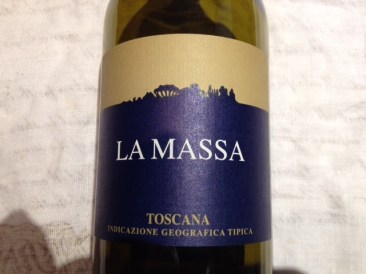
Pairing: Roasted Vegetable and Pepperoni Pizza with 2012 La Massa Toscana

Food: In our house, Saturday night is pizza night … has been for over thirty years. We’ve experimented with any number of crusts. Lately our favorite has been a sourdough crust based on a recipe from King Arthur. Toppings can be most any leftover veg. For this pizza, we roasted some tomato, summer squash, leek, and onion. Pepperoni and black oil-cured olives were added to the grated mozzarella. Classic (for us) … delicious.

roasted-veg-and-pepperoni-pizza

Wine: Over the years of eating pizza, we have enjoyed a lot of Italian red wines with all that pizza. The 2012 La Massa IGT Toscana has to rank up there as one of our very favorites. Other vintage years have been equally satisfying. Fattoria La Massa is located in the Chianti wine region of Italy near the town of Panzano about half way between Florence and Siena. The 2012 La Massa IGT is 60% Sangiovese with the remainder consisting of Cabernet Sauvignon, Merlot, and Aliante. The inclusion of Cabernet Sauvignon and Merlot (grapes most often associated with the Bordeaux region of France) gives this wine the identity of a “Super Tuscan”. Because of the inclusion of these grape varieties, they cannot call themselves a Chianti which has its own set of rules to follow.

la-massa-tuscan-red

Tasting: The nose reveals different black fruits (black cherry, black currant, blackberry). The palate continues the black fruit medley, but showcases the ripe black cherry. Leather and satiny tannins add further complexity. Although smooth, the wine also has the desirable “edges” typical of a good chianti. Very tasty with pizza.

Other Wines that Pair Well with This Food: Chianti Classico, Montapulciano, Merlot

Other Food that Pairs Well with This Wine:  Pasta with Tomato Sauce, Grilled Meats

Read About:    http://vinconnect.com/la-massa/

A Source:    klwines.com

Pairings with Pork? … Anything Goes!

Pairing: Roast Pork Tenderloin with 2010 Tait “The Ball Buster”

Food: Roast pork is one of those universal foods that goes well with almost any wine, red or white. For this meal we first pan-seared a pork tenderloin (seasoned with salt and pepper) until brown on all sides, then roasted it for about 20 minutes at 350. The sauce is made from black currant jam, whole black currants, a splash of soy sauce, and a few tablespoons of this wine. Combine in a saucepan and reduce until thickened bit. We’ve served the pork with broccoli and rösti potatoes.

pork-with-black-currant-darfin-potato

Wine2010 Tait “The Ball Buster” Leave it to the Aussies to come up with interesting and fun names for their wines. The origin of the name is explained on their website. This deep, lush, concentrated red is a blend of 77% Shiraz, 16% Cabernet Sauvignon, and 7% Merlot and comes from the Barossa Valley in South Australia. This region has a long, distinguished history in winemaking, as does the Tait name, particularly when in comes to crafting Shiraz and Cabernet Sauvignon. The Ball Buster has consistently won high praise over the years as a tremendous value for such a high quality wine (about $20 or less). This is a great wine … get it if you can.

tait-ball-buster

Tasting: This particular combination of grape varieties results in a terrific complexity of very pronounced aromas. Leather, earth and, most apparent, dark fruits … black currant, blackberry, and black raspberry. Every time you take a sniff, you get different smells coming to the forefront. On the palate, you get a smooth amalgam of flavors that can best best be described as hedgerow fruit leather (if such a thing existed!). Dark fruit jam with overtones of leather and earth is another way to describe this big, rich, powerful wine. Delicious! Maybe the name says it all!

Other Wines that Pair Well with this Meal: (white wines) Gewurztraminer, Chardonnay, Riesling, Vouvray. (red wines) Beaujolais, Pinot Noir, Zinfandel

Other Foods that Pair Well with this Wine: Steak, Grilled Lamb, Venison, Duck, Aged, Hard Cheeses

Read More: taitwines.com.au

A Source: southernwines.com    wine.com   

Chicken Pot Pie … Comfort Food with Comfort Wine

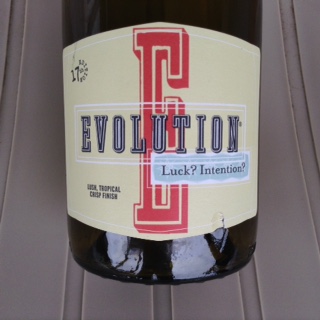
Pairing: Chicken Pot Pie paired with Evolution Lucky No. 9

Food: Comfort food, simply put, is food that gives us comfort. And, for us, nothing provides comfort better than homemade chicken pot pie made with a biscuit topping. There are a gazillion ways to make chicken pot pie, probably as many ways are there are people who enjoy eating it. We like to make it from the leftovers of a roast chicken dinner, picking off all the meat left on the carcass and combining the meat with leftover gravy and stock (and a little milk … thickened as needed), cut up carrots, celery, potatoes and onions, and a handful of peas. Put it all in a pie plate or casserole dish and bake at 350 until heated through. Some folks who make it with a biscuit topping, place the formed raw biscuit dough directly on top of the chicken mixture and bake it at higher temperature (400). In our experience, that method frequently results in an only partially cooked biscuit topping (raw on the bottom of it). So we cook the biscuits separately and place the biscuits on top of the filling just before serving. Most importantly, enjoy this comfort food with family or good friends. We did … just the other day … with dear friends!

chicken-pie

Wine: Evolution Lucky No. 9 is a white wine made by the Sokol Blosser Winery in Dundee, Oregon. It is a blend of nine different varieties of wine grapes. Yes … you read that right … nine grape varieties. They keep their blend a secret, though their website does admit to the inclusion of chardonnay and pinot gris in the mix. While drinking it, it’s fun to guess what the other grapes might be. Some might view this as a novelty wine …but this is seriously good stuff that we have enjoyed many times with many different types of food.

evolution-wine

Tasting: This is a positively delightful wine, well balanced, and bursting with flavor. The nose has a plethora of tropical fruit aromas, perhaps most notable is the distinct and wonderful smell of the Charentais melon (a small, intensely flavored, orange fleshed, European melon). Needless to say, the palate also has a focus on the flavor of this melon, but also combines many other recognizable tropical fruits. A “comfortable” wine that complements perfectly this comfort food.

Other Wines That Pair Well with Chicken Pot Pie:  Chardonnay, Pinot Noir, Pinot Blanc, White or Red Rhone Wine

Other Foods that Pair Well with Evolution: Chicken, Pork, Turkey, Asian Foods, Mexican Foods, or just by itself as an aperitif

Read More:  www.evolutionwine.com

A Source:  www.wine.com  Prince Edward Island Liquor Stores (a very available wine sold in many wine and liquor stores)